


Glycol Leak Detection in Data Centers: What Liquid Cooling Growth Changes
Rising rack density is pushing data centers toward liquid cooling, and glycol-based coolant now runs through a larger share of a facility’s loops, heat exchangers, and building envelope than it did a few years ago.
Glycol leak detection in this environment depends on continuous, inline monitoring of dye markers added to the coolant, since the fluid itself is colorless and can’t be measured directly. Rather than waiting for a leak to surface through a drop in coolant volume, a maintenance call, or a lab sample collected days later, dye-based photometric monitoring identifies the marker in condensate, drain water, or runoff at the moment a leak begins.
Key takeaways:
- Rising rack density is pushing the shift to liquid cooling
- Glycol coolant is colorless and can’t be measured directly
- Periodic sampling catches leaks well after they start
- Continuous monitoring detects leaks at trace concentrations
- Undetected leaks carry water-contamination and regulatory risk
Why Glycol Leak Detection Is Becoming a Bigger Priority in Data Centers
Rack Density and the Shift to Liquid Cooling
Air-cooled racks have typically stayed under 20 kW, a load conventional air handling systems manage without difficulty. AI training and inference hardware changes that math: every incremental kilowatt above that threshold pushes operators toward liquid cooling, and rack densities exceeding 30 kW are now common in GPU-heavy environments, according to research from Mordor Intelligence(opens in new tab).
That gap is why direct-to-chip and immersion cooling have moved from pilot projects to standard infrastructure across hyperscale and colocation facilities. The global liquid cooling market is projected to grow at a compound annual rate above 20 percent through the early 2030s, per Grand View Research(opens in new tab).
More Coolant Loops, More Exposure Points
Every additional loop, chiller circuit, or cold plate installation is another point where glycol-based coolant can escape containment. Facilities that added liquid cooling as a retrofit often route coolant lines through spaces not originally designed for fluid handling, alongside outdoor plant rooms, rooftop units, and transformer cooling systems already common in HVAC infrastructure. Density and speed of deployment are increasing faster than the monitoring built around them, which is a mismatch worth addressing directly rather than treating as a secondary concern.
What an Undetected Coolant Leak Costs a Facility
Water-Soluble Coolant, Broad Contamination Pathways
Both ethylene glycol and propylene glycol dissolve readily in water, so a leak is rarely contained to the spot where it occurs. Runoff, storm drains, and groundwater are all pathways for a small, slow leak to travel well beyond a facility’s footprint, particularly for outdoor equipment exposed to rainfall. A drip that would be minor if caught immediately becomes a wider contamination event the longer it goes unnoticed.
Regulatory and Reputational Exposure
Data center scrutiny has moved beyond utility bills and into legislation. Several states have introduced moratorium bills citing electricity and water impact, and local opposition has already delayed or blocked billions of dollars in projects nationwide within roughly a year, according to research firm Data Center Watch, as reported by CNN(opens in new tab).
That scrutiny raises the cost of a leak. Beyond remediation, a documented incident brings legal exposure and reputational damage that takes far longer to repair than the leak itself.
Weighing the Investment
Set against those potential costs, continuous monitoring is a modest line item. Instruments built around dye detection require no reagents and little maintenance, which keeps the ongoing cost of monitoring low compared to a recurring lab sampling program that bills per analysis and still misses the moment a leak starts.
The comparison holds regardless of facility size: the cost of instrumentation is fixed and known upfront, while the cost of an undetected leak scales with how long it runs and how far it travels before anyone catches it.
Why Conventional Monitoring Misses the Early Signal
Lab Sampling and Gas Chromatography Lag Behind the Leak
Periodic sampling and gas chromatography remain common ways operators check for coolant contamination, and both are accurate methods in a laboratory setting. Neither operates in real time.
Samples are collected on a schedule, sent for analysis, and returned with results hours or days after collection — by which point a leak has often been running the entire interval. Contamination is frequently identified only after it has already reached a drain, a waterway, or in industrial process settings, a finished product.
The Colorless Coolant Problem
Part of the reason detection lags is that glycol itself gives no visual or simple chemical signal. It’s clear, and standard water-quality checks don’t flag it directly. The workaround used across HVAC, data center, and industrial cooling applications alike is to mark the coolant at the manufacturing stage with a fluorescent or colored dye — commonly fluorescein or Brilliant Blue, both FDA-approved for use in food and pharmaceutical contexts — and monitor for that marker instead of the glycol itself.
How Glycol Detection Methods Compare
Several measurement approaches are used to check for glycol in rainwater and process water, and they differ in what they actually measure and how far below bulk concentration each one can resolve a leak.
TOC analysis
TOC analysis measures total organic carbon and can detect glycol into the low parts-per-million range regardless of coolant formulation. It requires reagents and regular servicing, and because it responds to any organic carbon in a sample, it can’t distinguish a glycol leak from other organic material in the water.
Conductivity
Conductivity measures ionic strength rather than glycol directly, since glycol itself is largely non-conductive. What it actually detects are the ionic corrosion inhibitors blended into the coolant, which in practice limits reliable detection to concentrations above roughly 5%. Other ionic inputs, such as road salt or runoff, can raise conductivity independent of any glycol leak.
Refractometry
Refractometry measures a fluid’s refractive index and works well for bulk-concentration checks, but only resolves glycol at percent-level concentrations. Trace leaks in the parts-per-million or parts-per-billion range fall below what refractometry can detect.
Fluorescence-based detection
Fluorescence-based detection measures a fluorescent tracer dosed into the glycol rather than the glycol itself. Because the tracer is specific to the coolant and detectable independent of inhibitor chemistry or rainwater composition, this method can reach parts-per-billion sensitivity. It depends on the glycol carrying a compatible tracer, which is standard in many commercially available glycol products.
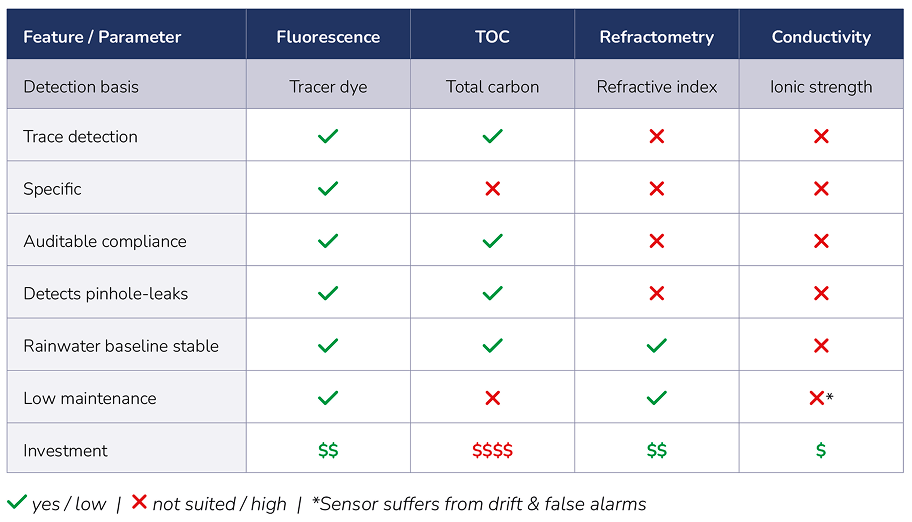
The practical distinction is what each method can resolve before a leak reaches a percentage-level concentration, since that gap determines how early a facility can catch a problem rather than confirm one after the fact.
How Continuous Monitoring Solves the Detection Gap
The Mechanics of Glycol Leak Detection
Continuous glycol leak detection works by measuring the dye marker photometrically in condensate return, drain water, or surface runoff, rather than waiting on a scheduled sample. Because the marker is detectable at extremely low concentrations, monitoring can flag a leak within moments of it starting rather than after it accumulates.
This approach is deployed across HVAC, data center, and industrial cooling systems alike, wherever continuous, source-level detection matters more than periodic sampling.
Detection at Trace Concentrations
Fluorescein is detectable down to ultra-low parts-per-trillion concentrations, and Brilliant Blue down to parts-per-billion, which means even a slow drip produces a measurable signal well before it would show up through volume loss or visual inspection. This sensitivity matters most in outdoor installations, where rainfall can dilute and carry a leak off-site quickly.
Built for Harsh, Unattended Environments
Rooftop units, plant rooms, and transformer substations aren’t controlled lab environments. Air bubbles, rust particles, and other particulates in the sample stream can produce false positives in less robust instrumentation, and unattended locations make frequent recalibration or reagent replacement impractical.
A fluorescence-based photometer designed for trace-level detection is built to hold accuracy in exactly these conditions, with no reagents required and minimal maintenance demands.
Data center operators evaluating cooling infrastructure upgrades are increasingly treating leak detection as part of that planning rather than an afterthought, given how directly it ties to both environmental compliance and operational continuity.
Technical Q&A
Talk to Kemtrak About Continuous Glycol Leak Monitoring
Kemtrak’s fluorescence-based glycol leak detection tracks coolant down to the parts-per-billion level, with a specified, documented detection limit rather than a general assurance of “small quantities.” Every analyzer ships with an auditable compliance certificate, and validation caps are available for routine verification checks, giving facilities a testable, documented record for compliance reporting year after year.
Facilities adding liquid cooling capacity or reviewing existing HVAC and data center cooling loops can request a quote from Kemtrak to discuss continuous glycol leak monitoring options for their system.
Read more: