

Glycol Leak Detection
Glycol-based coolants — including ethylene glycol and propylene glycol — are widely used in HVAC systems, data center cooling infrastructure, and high-voltage transformer cooling systems. Heat exchangers, chiller circuits, and cooling loops all rely on glycol as a heat transfer fluid. Many of these systems are installed outdoors — on rooftops, in plant rooms open to the elements, or at transformer substations — where leaks can be washed directly into storm drains, soil, and local waterways by rainfall long before they are ever noticed.
The environmental risk
Both ethylene glycol and propylene glycol are water-soluble and can readily enter groundwater, drinking water supplies, and surface water via runoff. Outdoor systems are particularly vulnerable: even a slow drip can go undetected for extended periods, with rainwater continuously carrying glycol off-site and into the environment. Early detection is therefore critical — to meet environmental protection requirements and prevent contamination of water systems before it occurs.
Trace detection at the source
The Kemtrak glycol detector provides continuous, real-time monitoring for glycol contamination at trace concentrations. Many glycol products are supplied pre-dyed by the manufacturer — for example, ethylene glycol coolants commonly contain fluorescein, the dye responsible for their characteristic green color. Where this is the case, no additional dye is necessary. In other cases, a suitable fluorescent dye can be added to the coolant. By monitoring for the presence of the dye marker in condensate return, drain water, or surface runoff, even the smallest leaks can be identified at the source the moment they occur. The detector is available as both a flow-through measurement cell and an inline probe, offering flexible installation options to suit different system configurations. Detection is possible down to parts-per-billion (ppb) concentrations, ensuring that even pinhole leaks or minor seepage are captured before they reach the environment.
Reliable performance in demanding conditions
Outdoor HVAC and cooling systems can present challenging measurement conditions, including air bubbles, rust particles, and other particulates in the sample stream. The Kemtrak glycol detector is designed to perform reliably in the presence of these interferences, avoiding false positive readings. With no reagents required and an ultra-low maintenance design, it delivers continuous protection without placing demands on operations staff.
Technology comparison: glycol leak detection in rainwater
Several technologies are marketed to measure glycol coolant leaks in rainwater, but the differences between them matter.
TOC analysis reliably detects glycol down to the low-ppm range, independent of coolant formulation. Its drawbacks are cost and upkeep — the analyzers are expensive and rely on reagents and regular servicing. It is also non-specific, flagging any organic carbon, not just glycol.Conductivity is promoted to detect "small amounts" of glycol, but the glycol molecule is essentially non-conductive — it registers only the coolant's ionic corrosion inhibitors. In practice this means concentrations above 5%, and any other ionic input, such as road salt, sea spray, or dust run-off, can trigger a false alarm, a common complaint with the method.
Refractometry is a bulk-fluid measurement that only resolves glycol at percent-level concentrations, so trace (ppm) leaks fall far below its detection limit.
Fluorescence works by dosing a fluorescent tracer into the coolant, so measuring the dye in the rainwater directly reveals the leak. It is therefore highly specific and reaches ppb sensitivity, independent of inhibitors or rainwater chemistry. Its one prerequisite is that the coolant carries a compatible tracer; however, many commercial coolants are already pre-dyed.
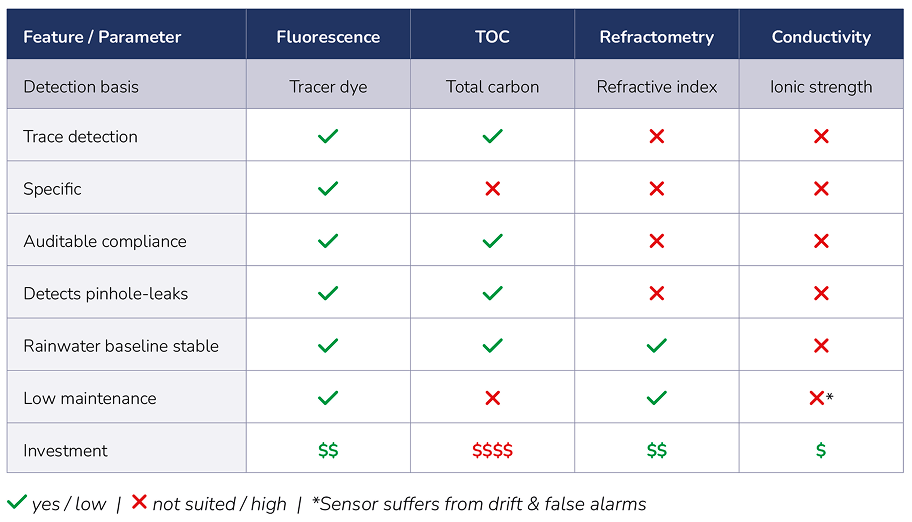
Plant operators face severe liabilities for glycol leaks. If an inspector asks you to prove the maximum volume your system could discharge before shut-off, what number will you show them? A method that cannot define a detection limit leaves the customer holding the full legal and financial liability. It is essential to select a method that provides a documented, quantifiable, and auditable trail.
In engineering, if you can't measure it, you can't manage it — and a sensor without a specified detection limit is a compliance gamble. The Kemtrak fluorescence-based system tracks glycol down to the parts-per-billion level, proving safety with auditable, absolute metrics rather than guessing at it. Every Kemtrak analyzer ships with an auditable compliance certificate, and validation caps are supplied for routine verification checks, ensuring complete, documented compliance year after year.
Benefits of a Kemtrak Instrument include:
- Continuous real-time monitoring for ethylene glycol and propylene glycol leaks
- Trace detection down to parts-per-billion (ppb) concentrations
- Protects groundwater, drinking water, and surface water from contamination
- Early detection at the source — before glycol is carried off-site by rainfall or runoff
- Measurement cell or probe installation options
- Robust performance — no false positives from rust, air bubbles, or particulates
- Ultra-low maintenance, no reagents required
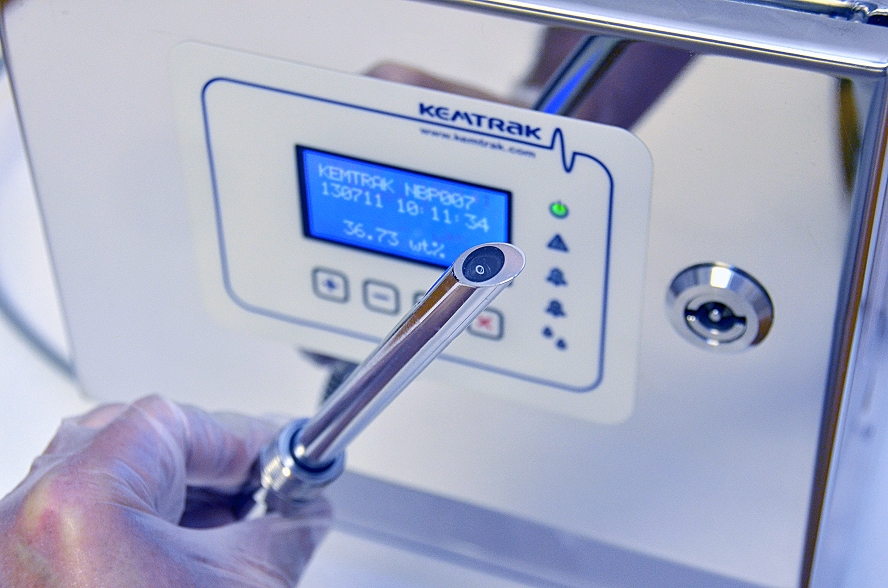
The Kemtrak FL007 Glycol Leak Detector is a fluorescence-based inline analyzer designed for early detection of glycol coolant leaks in heat exchangers, chillers, cooling water and condensate return systems, HVAC and district heating/cooling networks, data center cooling loops, and environmental discharge. By detecting a fluorescent tracer carried by the coolant, the FL007 provides highly specific leak detection with ppb sensitivity, independent of inhibitors or changing rainwater composition, while avoiding false positives from rust, air bubbles, or particulates. With excitation at 470 nm and detection at 520 nm, it can detect fluorescein down to 10 ng/L (ppt).
A long-life LED light source with a typical lifetime of more than 30,000 hours supports drift-free, low-maintenance operation, while scratch-resistant sapphire optics, no on-board probe electronics, and no moving parts make the system suitable for demanding industrial and hazardous-area installations. Remote zeroing, automatic cleaning, advanced signal filtering, and an auditable calibration certificate support reliable unattended operation, with Modbus TCP standard and EtherNet/IP or PROFINET available as options.
The Ø12 mm PG13.5 immersion probe matches standard industrial pH sensor dimensions, allowing installation with common fittings and retractable probe holders. Wetted materials include 316L stainless steel or Hastelloy C-22, with standard probe lengths from 120 to 425 mm and custom lengths available. Depending on configuration, the probe can operate at process temperatures up to 200 °C (392 °F) and pressures up to 50 bar (725 psi).
Resources: